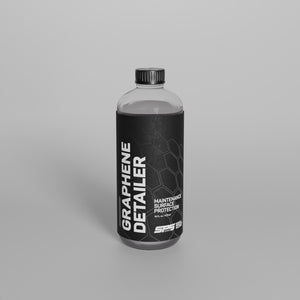
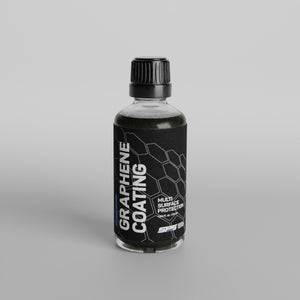
WILL IT BEAT THE EXISTING FORMULA?
SPS Next Gen Coating Testing // Update #1
We're back at it. 20 potential next-generation SPS pro-grade coating formulas are being tested. Only one will be crowned the winner. Learn more about how we're testing these out and how you know you can trust the R&D we put in.
 Joey Reinhart

Let's Set The Record Straight:
We're building what might be the best professional-grade graphene coating we've ever made.
Here's how we're doing it — and why it matters.
There's a version of this post where we just quietly reformulate, slap a "New & Improved" sticker on the bottle, and call it a day.
That's not how we operate.
If we're going to make something better — and we mean actually better, not marketing-speak better — we're going to do it the right way.
We're going to test it in the real world, on real vehicles, in real conditions, over a full year.
We're going to try to kill it.
And at the end, we're going to send the winning formula to a third-party lab for ISO-standard verification, because if we're putting our name on it, we're putting everything on it.
We've said since day one that SPS would underpromise and overdeliver.
This is Update #1. The start of something we think is going to be a big deal.
Why Fix What Isn't Broken?
Fair question.
Our current SPS Graphene Coating is genuinely great.
Our authorized installers trust it. Their customers love it.
It has great manners in terms of application, and delivers the kind of gloss and protection that makes people stop in parking lots.
But "great" has a ceiling. And we've always believed that ceiling should be higher.
So we went back to the lab. We handed our lead chemist, James Colton, a mandate:
Push the formulation further. Better durability. Better chemical resistance.
Better everything — without sacrificing the application experience that installers depend on.
James came back with 12 initial test formulas. He's working on 8 more.
The Test Matrix: C = Control (Base Formula) XL = Cross Linker
C1
C1-XL1
C1-XL1
C1-XL3
C1-XL4
C1-XL5
C2
C2-XL1
C2-XL2
C2-XL3
C2-XL4
C2-XL5
A Quick Video Overview:
The Science at a High Level
Here's what we can tell you without putting our chemistry on a billboard.
We're running two control formulas — C1 and C2 — each representing a distinct base formulation approach.
Against each control, we're testing five different cross-linker (XL1-5) variants.
Cross-linkers, for those who aren't deep in the coating chemistry world, are what determine how a coating's molecular network bonds together after cure.
Get it right, and you get a coating that's harder, more chemically resistant, and longer lasting.
Get it wrong, and you've got something brittle, unforgiving, or both.
We're not going to tell you which cross-linker is currently leading. That would spoil the fun.
But we will say: the early impressions have been hard to ignore.
The Test Vehicles
We needed vehicles that would actually stress-test these formulas.
Not garage queens. Not weekend drivers. Daily drivers with attitude.

TEST VEHICLE #1: JOEY'S 2025 TOYOTA TUNDRA
This truck doesn't have an easy life — and that's exactly why we chose it.
Joey is a backcountry camper, mountain biker, and snowboarder.
His Tundra does roughly 35,000 KM (20,000 ish miles for the freedom units) per year across every surface type imaginable:
City commutes, cross-country highway runs, forestry roads, mountain passes, and proper off-road trails.
Bug splatter, road grime, tree sap, mud, rock chips, highway salt — this truck sees it all, constantly.
If a coating can survive a year on this truck, it can survive almost anything.

TEST VEHICLE #2: CAM'S 2019 GOLF R
Cameron is a bit more civilized with his cars. A bit.
The Golf R is tuned, quick, and driven with intention.
Cameron puts about 20,000 KM per year on it (12,500 miles in I don't do kilometers) — mostly urban and highway driving.
But pushed harder than most with 30+ PSI of boost.
Different clear coat and substrates, different environmental exposure, different wash history.
Driving like what the average daily-your-racecar car enthusiast would do.
A completely different data set from the Tundra.
How We're Running This
THE TEST METHODOLOGY
Every exterior panel on both vehicles has been labeled and logged.
Each panel carries a specific formula from our test matrix.
Weekly Washes
We're not letting these vehicles sit.
The regular wash cycle is part of the test.
Water behaviour, soap resistance, and surface feel all get evaluated consistently over time.
Real World Contamination
These aren't test panels in a lab.
They're getting hit with everything that Calgary roads and Canadian backcountry can throw at them.
Because that's a real world test.
Active Destruction Testing
Towards the end of the year-long test period, we're going to stop being gentle.
Degreasers. Wheel acid. Harsh alkaline cleaners.
We're going to actively try to break these coatings and see which formulas hold.
Third-Party ISO Verification
The winner doesn't just get our stamp of approval — it goes to an independent lab for rigorous ISO-standard testing.
No bias. No shortcuts. Just proof.
What We've Seen So Far
We're early. This is Update #1 for a reason.
But we'd be lying if we said we weren't already excited about what's sitting on these panels right now.
The gloss is insane.
We've applied a lot of coatings over the years.
The depth and colour richness coming off these test formulas — particularly under direct light — is genuinely striking.
The kind of finish that makes you look twice.
The slickness is unlike anything we've applied before.
Water behaviour/hydrophobicity is exceptional.
The surface feel is in a different class.
If this carries through to durability testing, we have something very special on our hands.
Application and levelling are still dialled in.
One of our non-negotiables was that a next-gen formula couldn't come at the cost of applicator experience.
Our installers need a coating that behaves. So far, that box is checked.
Now comes the part that matters most: does it last? Does it outlive and outperform what we already have?
That's what the next 12 months are for.
Who This Is For
If this new formulation passes every test — real-world and lab — it becomes the next-generation SPS pro-grade coating.
It will be exclusively reserved for our SPS Authorized Installer Network.
That means every professional detailer who carries SPS products will have access to a coating that's been battle-tested, third-party verified, and built specifically to outperform what's already one of the better coatings in the market.
And for the DIY enthusiasts following along? You're getting a front-row seat to how a professional-grade coating actually gets made.
Not a marketing story, but the real process, including the failures and the surprises.
Stay Tuned
We'll be publishing updates as the testing progresses.
When something interesting happens — a formula surprise, a durability milestone, a destruction test result — you'll hear about it here first.
This is the process. This is what it takes to build something great.
Stay glossy out there.
— Joey Reinhart, Director of Growth, SPS Coatings